
Is organising politics via political parties a stupid idea?

Rohin
March 10, 2026
Dear reader, Welcome to the Veto Campaign, the home of what’s probably the best idea in the world.
If you look through this site, you will see that we identify a major flaw in electoral systems that has never been addressed, let alone tackled.
Voters are just a fuel that powers the system, rather than owners of it. We call it ‘lead, follow or get out of the way’.
You will see that the electoral system is, in fact, stupid, and that leads to other stupid things dominating it, such as the manipulation of voter sentiment and the prioritisation of party agendas over public interest.
This discussion brings us nicely to political parties. They are a stupid idea made for a stupid system, which, quite predictably, leads to stupid results.
Can you trust any political party, as it currently stands, to truly represent your interests??
It’s likely the answer is no. How do we know? Please take a moment to review the bar chart below. I promise you it is not cherry-picked; it’s a decent representation of the level of confidence people have in political parties in most so-called western “democracies”.
Source: World Values Survey
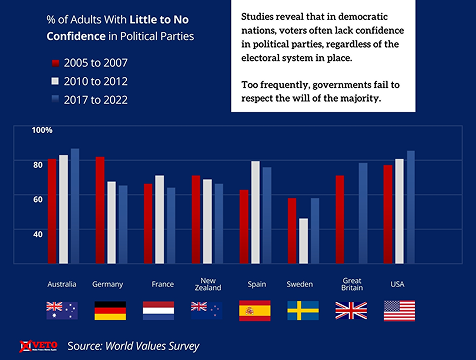
We heavily rely on this bar chart, and we believe it’s crucial to reiterate its significance, as the current state of affairs is truly staggering. However, we have become so accustomed to the situation that we view it as normal. It’s an abusive relationship where people from parties we don’t trust exercise a huge amount of power over our lives, spend our money, and run up massive debts, all without our consent. If this were an individual, they may well be convicted of crimes and imprisoned. Such behaviour is a widespread phenomenon.
Does this truly aligns with democratic principles? Is this the best we can do?
The solution is to have a VETO option, which allows voters to reject decisions made by elected representatives so that these representatives must have the consent of the majority to be elected. But I don’t want to go into that here. Yes, from time to time, they can represent a majority, but we can’t rely on them to do so, nor do we know when they do.
If we ever transition to a democratic electoral system, we believe that political parties in their current form will be viewed as an antiquated remnant of a preposterous system, and we will scoff at the notion that this absurdity had persisted for so long.
I am keen to explore why political parties in their current conception are a stupid idea.
This topic is important for us to understand. In no particular order:
- The Party Whip: Political parties provide a “set menu” of policies, candidates, and programmes. There is limited room for voters to influence what political parties propose, even if the majority may oppose many of them, which can lead to a disconnect between the electorate’s preferences and the policies enacted by their representatives. In addition, the party whip is in place to maintain discipline. He is the official tasked with ensuring elected members of the party vote in accordance with the party platform rather than their individual beliefs or constituents. If a member fails to maintain discipline, the whip can be pulled; this penalty effectively expels them from the party. Political parties actively prevent our supposed representatives from representing us or using their judgement.
- The Iron Law of Oligarchy (link to key concepts) essentially states that party leadership tends to reward loyalty to itself. Competence and integrity will be of secondary importance, and integrity may, in fact, be a detriment when rising up within a party’s organisation. One of the ways that central party leadership maintains control is by manipulating candidate selection, with chicken-runners and parachute candidates especially in “safe seats”. Can these selected candidates be trusted to represent their constituents’ interests over those of their party?
- Perverse Incentives: Each political party is under pressure to mislead the public over the effectiveness, or lack thereof, of their achievements and policies. For example, Sunak’s government in November 2023 claimed its policies to halve the rate of inflation were “working”, when in fact the drop being celebrated was a result of a drop in energy rates that had nothing to do with the actions of the government. When elections roll around, political parties often lie about their opposition using scare tactics and make promises that they do not keep when getting into power. We have this odd system where there is a party in power always pretending everything is better than it is and an opposition that will constantly claim everything is far worse than it is. It’s just another stupid part of a stupid system.
So, what can be done about it? We, at the VETO campaign, are about solutions, not commentary. The solution is you, if you are empowered with the veto. If you think you will not get someone to represent your interests after an election, you must veto it. We believe it’s our prerogative and duty to reject subpar representation, and not doing so does a disservice to ourselves, our families, our community and our nation.
How does this action affect the party system? Well, when voters take charge of the country, political party establishments become less important. Voters incentivise MPs to disregard their directives and seek the policies and resources their constituents demand. It will encourage them to reach across party lines to form alliances of mutual interest that can more effectively lobby for their constituents, leading to a more collaborative political environment that prioritises the needs and preferences of the electorate. It will encourage an organic grassroots reorganisation of how politics is conducted, potentially leading to new political movements that focus on local issues and community needs rather than traditional party affiliations.
What will happen is hard to say; perhaps organisations will emerge based on regional lines.
This makes more sense than dividing by political parties. It will be more difficult to use scare tactics and misleading claims, as this sort of negative campaigning will lead to more people choosing to veto the election.
The pressure to mislead will be replaced by a pressure to accurately gauge metrics so that resources can be allocated as effectively as possible.
Parliament could transform from a strange and curated spectacle of the opposition battling the party in power into a place of intense horse trading and coordination focused on improving the lives of the electorate.
The system we have now is stupid and is biased against representing voter interests, as it often prioritises party agendas over the needs and preferences of the electorate.
If we have people in charge who are acting in good faith and are doing their best, it can work ok, but once they depart from this standard, there is almost nothing voters can do about it.
Note: This is an updated version of the blog post originally published in May 2025.
I hope you found this blog interesting and thought-provoking. If you want to learn more, please explore the website or check out the petition and sign it
Demand the VETO Option: Get Real Democracy and Maximise the Common Good.
Great Job