
Is the Veto Option the Missing Tool in the UK’s Democratic Framework?

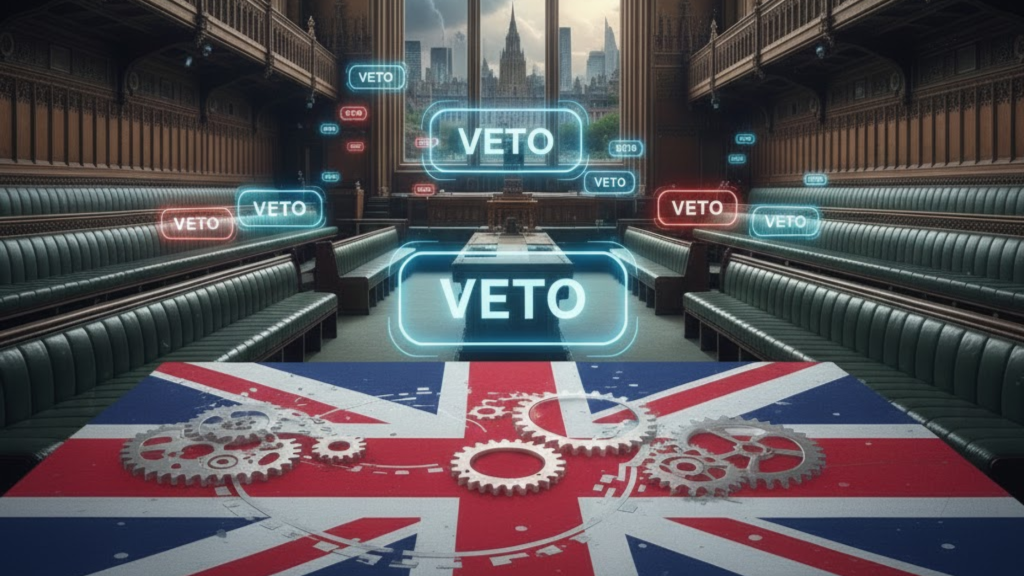
Here’s something that actually happened. In 2024, Keir Starmer won his seat in Holborn and St. Pancras with just 26% of the total electorate voting for him. That same year, 46% of eligible voters didn’t vote. Yet he represents everyone in that constituency. That’s not a bug in the system. It’s the feature. The veto option would change how we think about what a mandate actually means. It gives voters a formal way to say no when they genuinely believe nobody on the ballot deserves their consent.
The veto option differs from simply not voting or spoiling your ballot. It’s a formal choice on the ballot itself. You’d get the same power as someone who votes for a candidate. If a veto option hits 50% or more, the election gets rerun. That forces politicians to actually compete for your support instead of assuming they’ve got it. In the UK right now, you can’t formally withhold consent in any meaningful way.
The Consent Problem That Nobody Talks About
The UK election system operates on a simple principle. Vote for someone or don’t. But there’s no formal middle ground. No way to say, “I showed up.” I participated. But nobody here deserves my agreement to let them represent me.
Look at the numbers. Since 2001, neither major party has received more than 50% of the vote. Not once. Not even close. Yet they control overwhelming majorities in Parliament. In 2024 specifically, Labour won 412 seats with about 33% of votes cast. The Conservatives won 121 seats with 23% of the votes cast. Between them, they control 80% of seats on less than 60% of actual votes. That’s not representation. That’s arithmetic.
The real issue becomes visible when you factor in turnout. That Holborn and St. Pancras example isn’t unusual. It’s actually typical. When you include non-voters in the calculation, most MPs are elected without the consent of the majority at all. This creates what researchers call electoral oligarchy. A small number of people are elected under archaic rules that benefit two big parties, while everyone else gets locked out. The system doesn’t ask for consent. It assumes it.
Why Elections Shouldn’t Work Like Spending Your Money Without Permission?
Here’s the comparison that cuts through everything. If someone spent your money and borrowed more on your behalf without your consent, they’d face jail time. That’s fraud. That’s a crime. Yet election systems across democracies do exactly that. They elect officials with sweeping power who never actually proved they had majority backing.
The World Values Survey tracked this across multiple countries. In Britain, the percentage of adults with little or no confidence in political parties rose from 46% in 2017 to 52% in 2022. That’s not slightly skeptical. That’s fundamental distrust. The current ballot offers a false choice. Vote for someone you don’t really want because they’re the lesser evil. A veto option changes that. It says: I participated. I looked at these options. I formally reject all of them. That’s data politicians can actually use.
The Mechanics Matter More Than People Realize
A proper veto system triggers a rerun only if the veto reaches 50% or more. Not a plurality. Not 40%. A genuine majority. This matters because it respects that democracy means the will of the majority, not the will of any organised minority.
The signature threshold also matters. In Switzerland, referendums on legislation require 50,000 signatures. That’s roughly 0.6% of their population. The UK, with 67 million people, would need proportionally more signatures.
When a veto prevails, and an election is rerun, the seat remains vacant during the interim. Three to six months typically. This forces parties to actually investigate what went wrong. Party activists have to talk to voters. Candidates have to revise their platforms based on real feedback. That’s not chaos. That’s accountability.
Proportional Representation Doesn’t Solve This Either
Some people suggest that switching to proportional representation would fix the problem. PR does distribute seats more fairly by vote share. But it doesn’t answer the consent question. It just spreads the problem across more parties.
In a simplified PR model with veto, vacant seats would equal the veto percentage. If 30% choose veto, 30% of seats stay empty until candidates earn majority consent. That creates pressure across the entire coalition. Nobody can pass legislation without addressing what made voters reject all options.
PR without veto still elects MPs who represent zero voters. All seats get filled. But some MPs literally got there because they were sixth on a party list and nobody particularly wanted them. They represent an assumption of support, not actual support. The principle stays the same. Veto forces parties to measure and respond to the consent threshold, not just the vote threshold.
The Oligarchy Problem That Veto Actually Addresses
Robert Michels developed what he called the Iron Law of Oligarchy. All large organisations, including democratic ones, eventually develop leadership classes that reward loyalty and serve their own interests rather than those of the broader population. That’s not corruption necessarily. It’s structural.
This explains why people see politicians as out of touch. They often are. The system creates a disconnection by default. Party leadership matters more than constituent needs. Career progression matters more than delivering results. Money matters more than consent.
Veto creates a structural counterweight. It says, “We can remove your power if you don’t serve us.” That’s not removing representative democracy. That’s making it actually representative. That’s enforcing accountability through a mechanism rather than relying on politicians to feel morally obligated.
What You Can Do Right Now?
This isn’t something that happens without pressure. Parliament won’t suddenly decide to give voters real power. They’ll do it when constituents make it impossible to ignore.
Sign the Veto Petition:
Your first step is to sign the petition. When petitions hit 100,000 signatures, they get scheduled for parliamentary debate. Right now, the veto campaign is building momentum. Your signature adds weight. It tells MPs that people in your constituency actually want this.
Share this Conversation:
Talk to people in your local area. Ask them if they felt they had genuine consent in the last election. Ask them if they’d use a veto option. Most people get it immediately once they understand what it means. Consent is basic. They’re angry it doesn’t exist.
Get Involved with the Veto Campaign:
Follow the Veto Campaign on social media. Read the whitepaper yourself. Understand the arguments deeply so you can explain them to others. Movements need people who actually understand what they’re fighting for.
Final Thoughts: The Path Forward for UK Democracy
The Veto Campaign has gathered momentum. The petition sits on Parliament’s petition website. Electoral Reform Society and Unlock Democracy both advocate for variations of this mechanism. This isn’t fringe anymore. It’s entering mainstream conversation.
Democracy in the UK claims to rest on consent. The veto option is simply the tool that makes consent real instead of assumed. Whether that tool gets adopted depends on whether enough people demand it.
The system won’t change itself. Keir Starmer was elected with 26% of the vote in his constituency. That’ll happen again in five years unless voters demand something different. The veto option exists as a proposal. Now it needs people who are willing to argue for it.
Disclaimer: The views expressed in guest-contributed articles are solely those of the respective authors and do not necessarily reflect the official stance of the Veto Campaign. We encourage diverse viewpoints to foster informed dialogue around the Veto Option and its impact on electoral reform.
[…] If you believe your vote should have the power to demand better, take action and study how a Veto Option can strengthen UK democracy. […]