
Why the Veto Option for UK Elections Could Become the Next Major Reform Debate

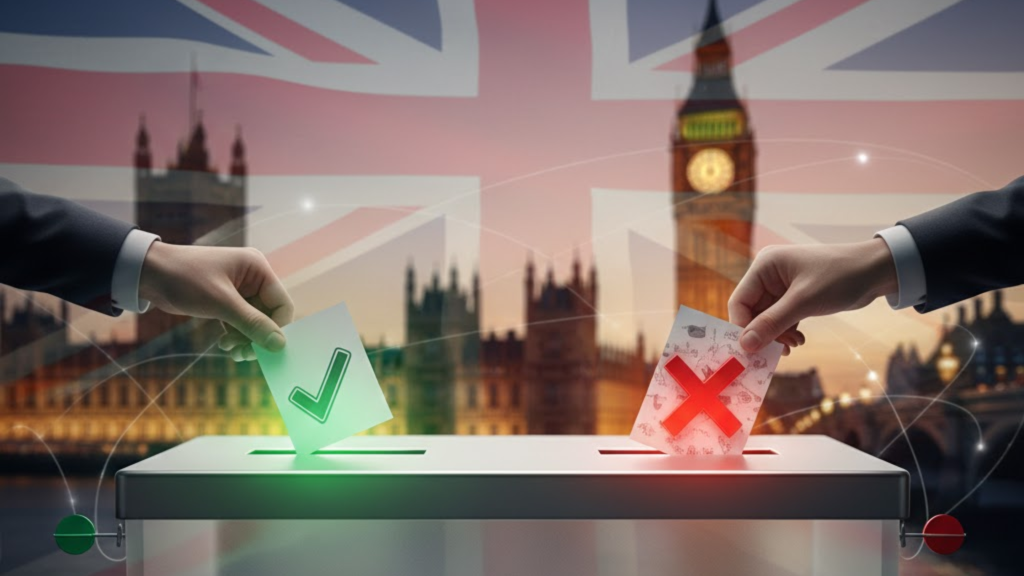
Imagine it’s election day. You walk into the voting booth and look at the candidates. None of them feels right. It is because deep down, you know none of them actually represent what you sense the majority wants. The country feels split. The options feel narrow. And you’re forced to choose: vote for someone you’re not confident about, or don’t vote at all. That’s the trap most democracies live in. We accept that elections pick winners, but we never really ask whether the winners reflect what the majority actually wants.
What if we could? What if voters had the power to look at the available options and collectively say: “That’s not good enough. We need candidates who genuinely reflect what the majority wants.”
That’s where the veto option changes everything.
A Reform Debate the UK Didn’t Expect
The veto option for UK elections works like this: voters get one additional choice on the ballot; they can vote for a candidate or select the veto option. If a veto reaches a majority (50% or more), the entire election is rejected, and a rerun is held. This isn’t about swapping one winner for another. It’s not about choosing the lesser evil. It’s about saying: the majority doesn’t want any of these options. Let’s start over and find candidates the majority actually wants.
The difference is crucial. Every other reform tries to help voters choose between available options. The veto option lets voters reject all options simultaneously and demand better ones.
What’s driving this shift? Look at the numbers. In the 2019 General Election, over 22 million votes, that’s 70.8% were completely wasted. They didn’t produce a candidate that the majority supported. They didn’t reflect what most people wanted. When election results don’t reflect majority preference that badly, the system stops being democratic.
Here’s what’s fueling the momentum:
- Voter turnout continues to decline, suggesting disengagement isn’t just apathy; it’s strategic avoidance.
- Nearly 20% of people voted tactically in 2017, choosing a candidate they didn’t actually want over one they feared more.
- Trust in institutions isn’t recovering; it’s stuck at historic lows.
Ready to give voters real control over who represents them? Sign the petition today and help make this reform a reality across UK constituencies
Why Is Election Reform Gaining Momentum in the UK Today?
Voters are demanding something the current system can’t deliver: real influence over outcomes. The appetite for reform is shifting from academic discussion to grassroots pressure. This isn’t coming from politicians wanting to redesign their own system. It’s coming from people who feel the system isn’t listening to them.
Why now? Because the gaps have become impossible to ignore. When only 12% of Britons trust political parties, and 63% believe politics is rigged to advantage the rich and powerful, the legitimacy of elections itself comes into question. People aren’t just unhappy with who’s in power; they’re questioning whether the game is fair.
Key factors pushing the conversation forward:
- Electoral Disappointment Cycles: Each election produces millions of “wasted” votes, building frustration.
- Digital Mobilisation: Campaigns like the 2019 Brexit petition that gathered 5.8 million signatures show voters will engage if they believe their voice matters
- Cross-party Dissatisfaction: This isn’t a left vs. right issue; it’s centred on fundamental fairness.
- International Reference Points: Voters are aware that other democracies have mechanisms such as judicial vetoes or recall options.
- Media Coverage of First-Past-The-Post Failures: Stories about MPs elected on 30-something percent support are becoming commonplace.
Modern Pressures Pushing the UK Toward Reform
Democracy is under pressure everywhere, but the UK faces a specific challenge. Most MPs take office without winning a majority of the vote. The House of Lords can delay bills for up to a year under the Parliament Acts, but it’s unelected, which raises its own legitimacy problems. Judicial review exists, but only around 5% of cases even reach a full oral hearing. What’s missing is a mechanism that puts power directly in voters’ hands.
When governments can push through laws without meaningful checks from the people they claim to represent, democracy starts to feel like a rubber-stamp process. Bills pass quickly, but they pass without the kind of public consent that sustains long-term legitimacy.
The modern pressures are real:
- Polarisation makes it harder to build traditional cross-party consensus.
- Short election cycles encourage short-term thinking over sustainable policy.
- Corporate and donor influence shapes agendas in ways ordinary voters can’t match.
- Public opinion and formal institutional checks have drifted apart.
How the Veto Option Strengthens Voter Control for UK Elections?
Here’s what actually matters in democracy: does power sit with the majority, or with whoever can manipulate the rules best? Right now, the answer is obvious. Nearly 20% of voters chose someone other than their preferred candidate in 2017 just to avoid a worse outcome. That’s not voting. That’s strategy. That’s people abandoning what they actually want because the system forces them to pick the lesser evil.
Veto ends that trap. When voters know they can reject the entire election if the majority doesn’t support any available option, they vote their actual preference, not their fear. If most people think all candidates are inadequate, a veto gives them the power to say so collectively and bindingly. New candidates get nominated. The election reruns. This time, hopefully, the majority actually wants someone.
This transforms voting from tactical compromise into genuine expression. The majority finally gets what the majority wants. Not what’s least bad. Not what wins a fragmented vote. What the majority actually supports.
The accountability shifts work like this:
- Elections must satisfy majority preference, not just technical vote counts
- Lesser-of-two-evils voting becomes irrelevant when people can reject both
- Candidates can’t survive on vote-splitting; they need an actual majority appeal
- Power structure flips from “least bad option wins” to “majority has real choice.”
What Role Does the Veto Campaign Play in the UK Reform Movement?
The veto election campaign in UK is doing something different from traditional political campaigns. It’s not telling people how to vote. It’s awaring people have a right to reject.
Veto campaign is connecting with voters who’ve given up on the idea that voting matters. It’s offering them a framework to think about what democratic accountability should actually look like. It’s also building evidence that demand for this reform is real, not academic speculation, but genuine citizen interest.
What the Veto campaign actually does:
- Educates about how the veto works and why consent matters.
- Gathers support from people across the political spectrum.
- Builds momentum ahead of any formal policy debate.
- Connects local voter concerns to the need for systemic change.
What Would Adoption of Veto Look Like? A Step-by-Step Look Ahead
Reform rarely happens overnight. There’s usually a pathway: awareness, debate, pilot schemes, national conversation, legislative change. The veto option would probably follow a similar arc.
Step 1: First comes awareness, which is happening now through campaigns and media coverage. People need to know it’s an option before the debate can begin. This is exactly why signing the petition matters right now. Early support signals to politicians and media that demand exists. It’s not about reaching a magic number. It’s about showing the trend, proving citizens genuinely care about this, and forcing the conversation onto agendas where it might otherwise get ignored.
Step 2: Then comes the debate. This is where academics, politicians, and voters argue about design details. It could take 2-3 years. Reform UK’s local elections 2025 and mayoral elections 2026 could serve as testing grounds for new ideas, including the potential piloting of veto mechanisms at that level. Every petition signature, every conversation, every person who signals they want this change accelerates this timeline.
Step 3: Next would come pilots, maybe trying veto at the local government level first, seeing how it works, refining the model. By then, the groundwork laid in the awareness phase determines whether pilots receive serious consideration or are dismissed. Then the national conversation intensifies, polling data accumulates, and political parties realise ignoring it costs them. The stronger the petition, the earlier that realisation arrives.
The realistic roadmap:
- Year 1-2: Awareness building and debate (we’re roughly here now, this is when early support builds momentum)
- Year 2-3: Academic and policy analysis, political party positioning (petition signatures influence where parties position)
- Year 3-4: Potential local pilot schemes emerge (proof of concept happens in local elections)
- Year 4-5: National political debate intensifies (veto option becomes unavoidable in manifestos)
- Year 5+: Legislative change becomes viable depending on election results
Right now, we’re at a stage where signing the petition directly shapes whether this becomes inevitable or fades away. Early support doesn’t guarantee success. But it’s the only thing that makes success possible.
Final Thoughts
The veto option isn’t inevitable. Reform debates go nowhere all the time. What makes this different is that it’s coming from voters who’ve stopped waiting for permission. Electoral reform examples from history show us that change happens when the gap between how things work and how they should work becomes undeniable.
Reform begins with awareness. It requires people to understand what’s broken and what alternatives exist. It needs campaigns willing to do the unglamorous work of education and mobilisation. If you believe every vote should carry real power, if you think democracy means more than choosing which team gets to ignore you, then the conversation is already starting. The Veto Campaign is building momentum for something that once seemed impossible: a system where voters don’t just choose between options, but can reject all of them and demand better.
Ready to be part of this conversation? Sign the petition at the Veto Campaign and join thousands of voters who believe consent isn’t optional, it’s essential.
Disclaimer: The perspectives presented in guest-authored content on this platform do not necessarily reflect the Veto Campaign’s official position. We believe that sharing varied viewpoints fosters a deeper understanding of the Veto Option and its potential to influence the electoral system.