
Democracy doesn’t work unless we make decisions by majority consent.

This lesson is the key takeaway from this campaign.
There is no way around it.
Let’s prove it using the first principles.
Democracy means that the people are sovereign (the ultimate authority). I hope we can all agree on this point, as this leads to everything else.
This principle means that if the people are to be sovereign, they must be free; if not, they can’t have authority.
If you are free, then that must mean you have rights that guarantee your freedom, i.e., the power conferred by the democratic process is constrained and limited by individual freedom. (Think of the US Bill of Rights.)
Free people must live on a land of defined boundaries where their freedom can be defended and their rights enforced; there is no freedom without land.
Within those boundaries, the people are sufficiently united to make decisions that satisfy the majority. If they can’t, it’s not a democracy; it needs some form of tyranny to hold it together, as a lack of consensus among the people often leads to oppression or authoritarian rule to maintain order.
All people must be equal. If there are people with special privileges, then we can’t have democracy, as they undermine the authority of others and create an imbalance that favours certain individuals or groups over the general population.
Thus, governance can only happen with the consent of the governed and the will of the majority.
Nothing else is democracy.
Every type of democracy includes two features – majority will and individual freedom – which are essential for ensuring that the rights of minorities are also protected within the system.
I understand that we often refer to any process involving voting as ‘democracy’, and I consider this somewhat frustrating.
It’s not.

This vehicle is a unicycle. It’s not a type of bicycle with one wheel; it’s not a faulty bicycle. That is absurd.
It’s a different thing with a different purpose (think clowns and circuses) with its own particular characteristics.
When we fail to respect the will of the majority, we undermine democracy. What we have is an electoral oligarchy, with its own peculiar characteristics.
The Problem
If we don’t ensure majority consent is obtained (or as close to it as practical) at every election, we are dooming ourselves to, at best, suboptimal governance or, far worse, a spiral into stagnation and decline that can last years.
If you believe a minority can consistently make better decisions than a majority, then you think democracy doesn’t work. If that’s the case, then nothing can be done to reliably maximise the common good.
It’s obvious we can’t rely on a benign, selfless minority to make beneficial decisions on behalf of the majority as if they were their pets or children.
It’s self-contradictory and not how the world works.
We can see the fruits of this process now.
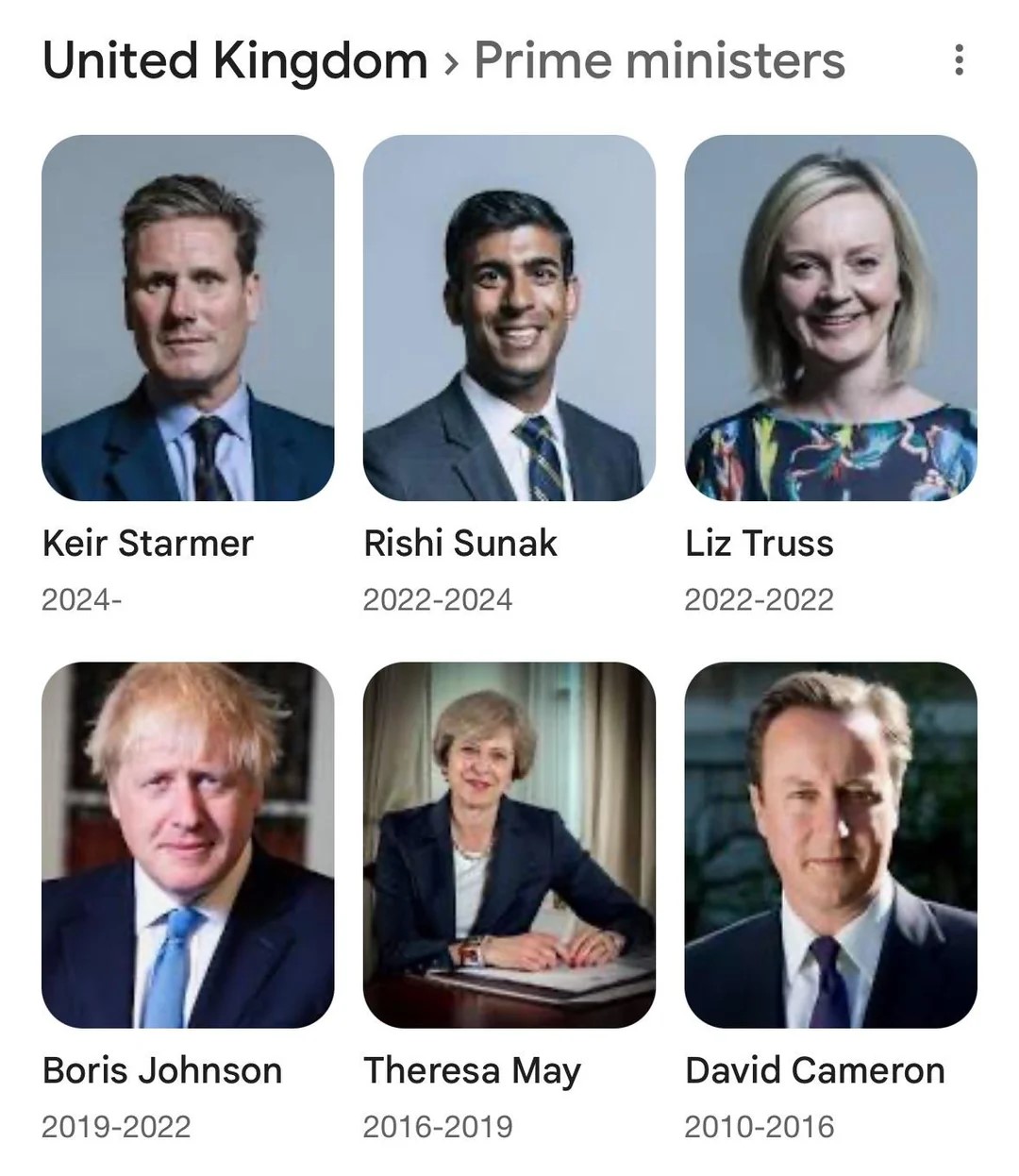
Politicians should only succeed if they truly represent our best interests, which is what representative democracy should be all about. The VETO bakes that into the system, making sure leaders actually work for us.
The Solution
Voters can’t run the machinery of governance directly; it’s too complex. We require experts, but we must resolve an underlying tension.
How do we ensure these “experts” work on our behalf?
The answer is a failsafe built into the electoral system that ensures voters can reassert control when the “experts” no longer benefit the majority.
We call the failsafe “the VETO option”.
The VETO option serves as an improved version of the “none of the above” (NOTA) option. It is included on all ballots for legislative positions in government. If a majority of voters choose the option “I VETO this election”, the result is void and the election is rerun within 3 to 6 months.
There is no limit on the number of reruns, nor does it ban previous candidates. Both are important features. Voters can veto elections for many reasons:
- There is no-one on the ballot that can adequately represent you.
- Their choice has no chance or is uncertain to win
- The likely winner is unacceptable to them.
- The voter believes that addressing policy issues is necessary before they can cast their vote for a candidate.
- It could be prosaic local issues, like crumbling roads, poor schools, lack of safety, or anything they see fit. Don’t underestimate them; resolving these issues requires competent and coordinated policymaking and resource allocation.
Currently, voters have relatively little leverage in an electoral system where they must choose between options and cannot withhold their consent until they think there is something worth voting for, which contributes to a sense of disenfranchisement and may lead to lower voter turnout in future elections.
It’s ok when we are bumbling along, but when things go sideways is when the veto is most needed.
In the 2024 GE, Labour got 411 seats with 10 million votes, Conservatives got 121 seats with 7 million votes, Reform UK got 5 seats with 4 million votes, Liberal Democrats (LD) got 72 seats with 3.5 million votes, and Greens got 4 seats with 2 million votes.
The incoherence of the FPTP (First Past the Post) system, low turnout, and tactical voting played a major part in the breakdown of votes and seats gained.
If you contemplate the FPTP ballot, it’s absurd (I use that word a lot). You are supposed to vote for someone even when you know they will or might lose. It’s designed for a two-party system; when you start adding in more than two parties, it becomes incoherent, and many people’s votes count for nought.
What’s the point of that? Then there are all the people who didn’t vote.
Given that so many stayed at home and the large numbers of tactical voters (about 39% of LD voters), the presence of a veto could have been a crucial feature of the 2024 GE.
What is the Reform/Restore/Green Party other than a repudiation of the status quo that can be directly manifested by a veto option? Why should voters have to use a proxy and rely on it to deliver on its promises when they could veto them instead?
Voters should mould political parties to fit their needs, not the other way around.
We could see a whole new way of governance take shape. Doesn’t it make more sense that grassroots political organs form along regional lines where all who go to parliament are united in trying to maximise the common good and engage in intense horse trading to try and achieve the best for their voters?
How does the current paradigm of the opposition and the ruling party throwing barbs at each other help us? They are both minority parties opposing one another.
A veto signifies a significant shift in the power dynamics between political parties and voters.
What about proportional representation (PR)?
Won’t that solve everything?
It has the same flaw as FPTP: it’s lead, follow, or get out of the way.
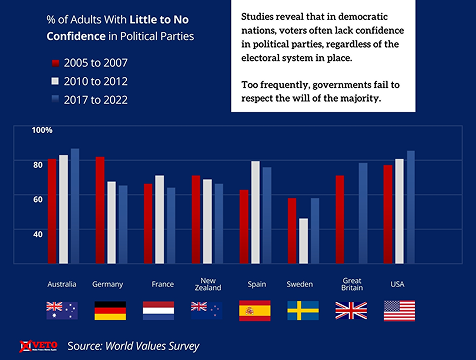
Countries with PR (proportional representation) systems still almost always lead to governments formed by political parties in which voters don’t trust.
New Zealand changed from FPTP to PR in the 1990s, and a supermajority still has little trust in political parties, similar to us here in the UK.
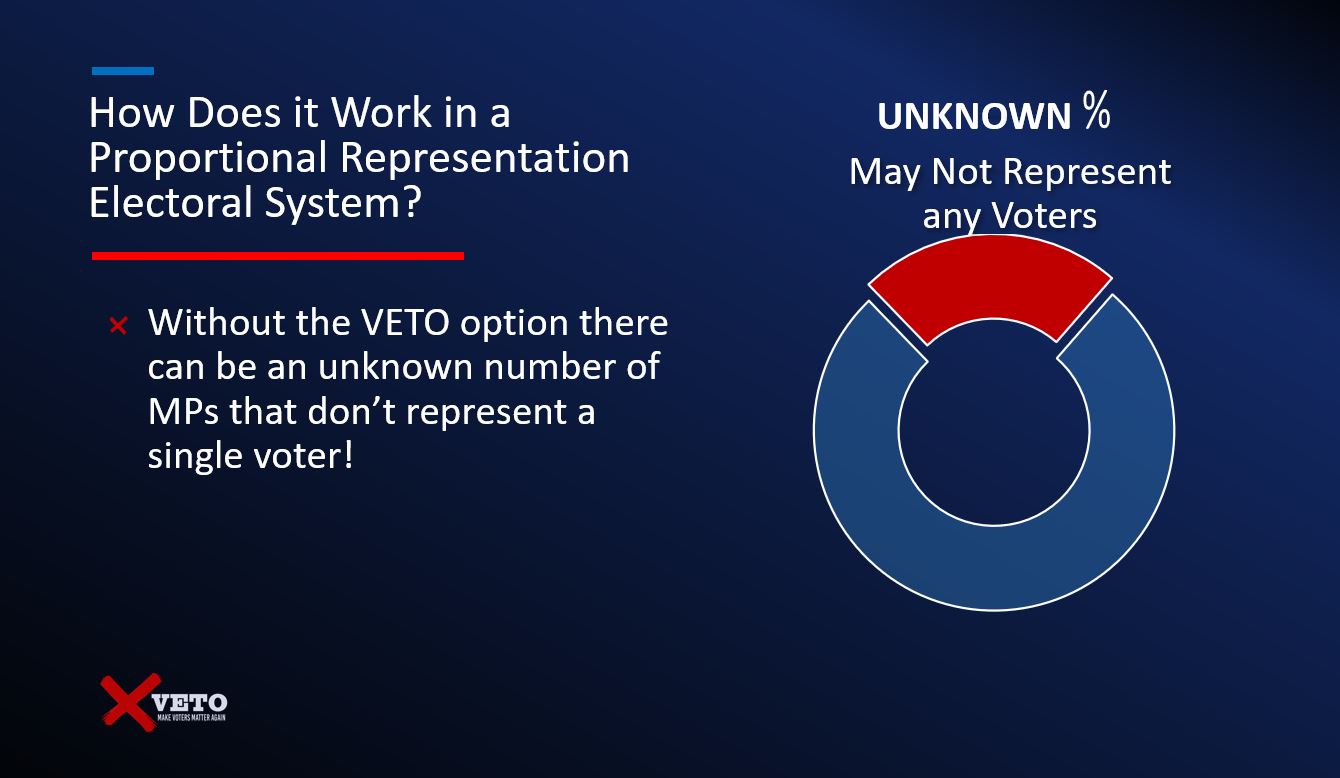
There are many types of PR, but the fundamental issue is that it assigns 100% of the seats without ensuring that everyone who wanted to vote has representation.
For instance, if the UK had implemented proportional representation (PR) in the last election and the turnout remained at 60%, then MPs would have received all 650 seats.
But what if 10% of those who didn’t vote did so because they felt unrepresented by the choices on offer?
Should those 65 seats out of 650 be allocated to MPs? Would more people choose to veto if it were available eg tactical voters or reluctant voters?
If so, then it means that at least 65 MPs don’t represent a single voter!
Isn’t it wrong?
The veto campaign certainly thinks so. Those 65 seats should remain empty. The rest can be assigned in proportion to their vote share; therefore, coalitions can be built in the same way as without the veto but without seats being filled with people who dont represent any voters.
If people choose not to vote, that’s fine, but we must ensure those unrepresented can make their presence felt. How else can we maximise the common good?
The principle by which we apply the veto in a PR system is that the proportion of empty seats matches the proportion of voters who chose to veto the election. This principle means that in future elections they will have an opportunity to gain representation.
PR systems typically lead to coalition governments, and a veto will motivate these coalitions to govern efficiently or risk losing even more seats. There is nothing like the prospect of losing your job to concentrate your mind on performing it well.
How can we tell if any reform is working without a way for voters to show their discontent?
It’s vital to understand that a veto option is not merely a desirable feature; it is a fundamental democratic requirement that enables voters to retain direct control over their governance within a representative democracy.
We are baking extremism and suboptimal governance without it.
The veto allows voters to send a strong signal where things are going wrong and the incentive to rectify those issues without large-scale disturbance. It’s an essential tool to aid governance.
Is there any empirical evidence that it works?
Critiques typically fall into one of two extremes.
- It will be used so frequently that no candidate will ever be elected again.
- It’ll never be used.
The first scenario is less likely than the second. It’s difficult to believe the veto will be used so often that it will prevent someone from being elected over and over again.
But let us presume that such a result is possible.
Then it implies that the constituency is not truly a constituency. Isn’t it better to expose that than to sweep it under the rug and organise a group of people into a constituency where the majority will always be ignored, regardless of who is elected?
Under such circumstances, we would need to either redraw the constituency to accommodate a majority or transition from FPTP to a more nuanced system.
Isn’t that a better end than forcing mismatched people together in a way that harms the majority?
The recent by-election in Gorton & Denton uncovered a schism. Now, the electorate is divided between two distinct populations. Do they belong together?
The same applies if we find the veto used widely nationwide.
This is why the veto is essential to democracy and acts as a tool for optimisation. If the veto gains a majority or is used frequently and widely, is the UK still a nation? I don’t believe this is the case, but at the very least, we can discover early indicators of broad dissatisfaction and require elected officials to address them, rather than enabling undemocratic politicians to continue wreaking havoc until it’s too late to remedy the problems.
What about the claim that it will never be used sufficiently to be a factor?
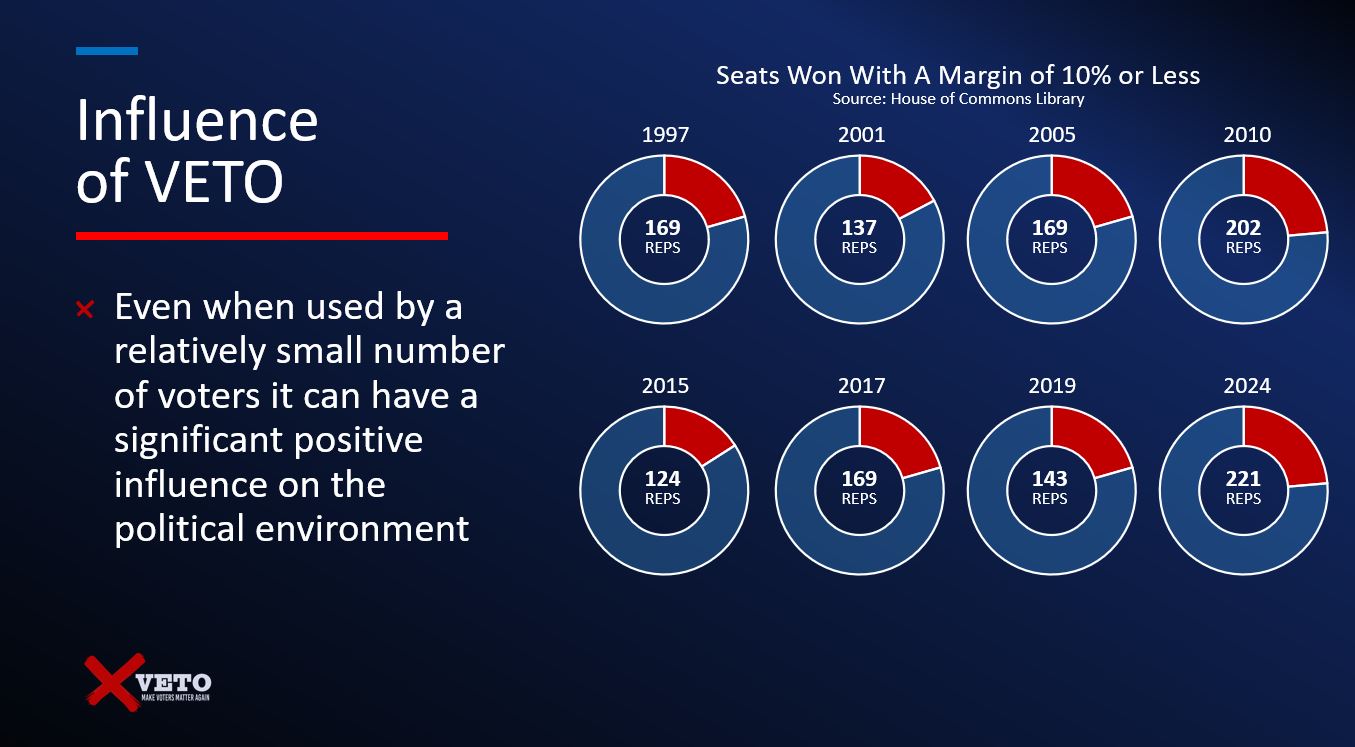
Many seats are decided by margins of less than 10%. A high veto potential is not necessary to begin to influence elections.
First, I want to point out that confidence in political parties has remained below 17% for the past 20 years.
Second, is the rise of parties such as Reform and, more lately, Restore/Green anything more than a manifestation of the desire to overturn the status quo? This is ultimately what the veto represents: an umbrella option in which anyone who opposes the existing status quo can have a clear voice.
Why wait for a party that may betray voters like established ones or be forced to accept extremism, as there is no other option? We must wait years, putting our faith in those we do not trust.
What a bizarre position for voters. Everything is so half-baked.
Third, in 2015, the Political & Constitutional Reform Committee (PCRC) found that the “None of the Above” (NOTA) option generated the most interest of all the proposed political reforms, with 72% of almost 15,000 respondents supporting its inclusion on the ballot. This finding prompted the committee to request an investigation into its inclusion. The newly elected Cameron government quickly disbanded the group, leaving no further information available.
That’s all fine, but what about the real world? Where has it been used previously?
To be honest, in its totality, nowhere; it’s a novel concept.
However, there is a real-world parallel from which we can draw lessons, and it is located in Russia. Which is annoying because it conjures up bad juju.
Russia abandoned it in 2006 because (spoiler alert) it limited the state’s capacity to impose its will on voters.
Russia was and remains authoritarian, but the “against all” choice hampered the state’s capacity to impose itself.
The option was generally available from the 1990s until 2006, when it was gradually phased out.
We see that its use rises when voter anger is highest, as expected.
For example, over 100 incumbent communist officials were ousted, necessitating replays because voters could cross off all of the names on the ballot in 1990. This was later codified as an “against all” option, which could lead to reruns in certain cases.
In general, its use ranged from 5 to 15%, with occasional spikes, particularly in metropolitan areas where it was perceived that the state was going too far in imposing control.
It’s important to remember that even if it wasn’t widely used, it still had influence. It’s mere appearance on the ballot should prompt politicians to change their behaviour and policies to prevent its widespread use.
And this is the pattern we observe in Russia. In areas where “against all” polled well, parties responded by fielding more acceptable candidates and making changes. It could not defeat a corrupt regime like Russia, but it caused enough trouble that it had to be abolished.
There was debate about bringing it back in 2014, and a public opinion poll found that 43% wanted it back, 21% opposed it, and 32% were neutral.
Ultimately, that’s what matters; it was something people appreciated much beyond its actual use, as it wielded power without being used.
What is better than that?
Thank you, dear reader, for sticking with me so long.
I want to leave you with a philosophical proposition.
The veto campaign believes that the basis of most evil in our world is the ability of people who do not bear the consequences of their decisions to make decisions that impact everyone else. Would you agree?
Don’t you think the best way to eliminate evil is to let those who bear the consequences of their decisions make them?
221 seats in the 2024 election were won with margins of less than 10%. Can you imagine the impact of the veto in that election? Do you think we would have the government we have now? Would we have ended up with something like the last Conservative government?
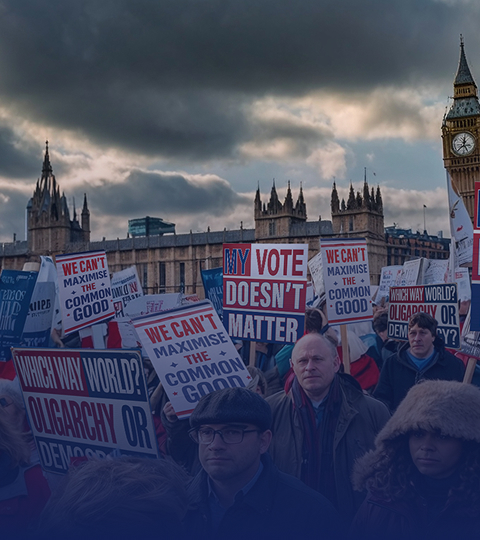

The Petition. PLEASE SIGN!
Join the Veto Campaign - Power Back to the People
The electoral system in place is not democratic. It is based on the “lead, follow, or get out of the way,” principle which cannot guarantee majority representation. It prevents voters from self-governance and thereby maximising the common good. The VETO enables voters to reject an election if they believe it will not provide them adequate representation. The veto restores voter sovereignty by requiring majority consent.
The next UK general election is likely by 2029. By then, let’s demand VETO on ballots.
Click the link that will lead you to the petition on
– we are aiming for 20,000 signatures. Please help us make it a reality. Please sign & share.
Contact us: contact@vetocampaign.com.
Please click the button below to sign the petition. Join us in trying to make the UK into a place where we can all prosper and live in freedom.